

Note
Panic attacks are a medical condition. These affirmations are a coping tool, not a replacement for professional treatment. If you're experiencing frequent panic attacks, talk to a healthcare provider about therapy, medication, or both. Crisis resources are listed at the bottom of this page.
Up to 11% of Americans experience a panic attack in any given year. That figure comes from the Cleveland Clinic, and it translates to roughly 36 million people annually.
Most won't have a panic disorder diagnosis. They'll just have a body that fires a false alarm so convincing it feels like dying.
These 35 affirmations for panic attacks are organized by when you need them. The phrases for mid-attack are different from the ones for the hours after or the days between. Your brain can't process the same language in all three states, and pretending otherwise is why most affirmation lists for panic don't work.
What Your Brain Does During a Panic Attack
Your amygdala fires a threat signal. Adrenaline and cortisol flood your bloodstream. Heart rate spikes. Breathing goes shallow. Your prefrontal cortex, the part responsible for rational thought, loses influence.
This matters for affirmations. Positive self-statements generally require belief. Belief requires prefrontal processing. During a panic attack, that processing power drops significantly.
That's why "I am calm and in control" fails mid-attack. Your brain knows it isn't true. A 2009 study in Psychological Science by Wood, Perunovic, and Lee found that positive self-statements made people with low self-esteem feel worse, not better. The gap between what you're saying and what you're feeling increases distress instead of reducing it.
The fix is simpler language. Factual claims. "I am breathing right now" works because your body can verify it in real time. No belief required.
A 2025 meta-analysis in American Psychologist (Wang, Zhang, Chen, and Hu; 129 studies, 17,748 participants) confirmed that self-affirmation reduces anxiety and improves well-being, with effects persisting for weeks. Neuroimaging research at Carnegie Mellon by Dutcher and colleagues (2020) showed how: self-affirmation activates the ventromedial prefrontal cortex, strengthening the brain's ability to regulate threat responses.
The type of affirmation matters as much as the timing. The phrases below are sorted by cognitive state, from the moment panic peaks to the quiet days between episodes.
When You're in the Middle of It
Panic attacks peak within 10 minutes. During that window, your body is in full fight-or-flight. Complex thoughts won't land.
These affirmations are short on purpose. Pair each one with a slow exhale: in for four counts, out for six. The extended exhale activates your parasympathetic nervous system, the braking mechanism your body needs right now.
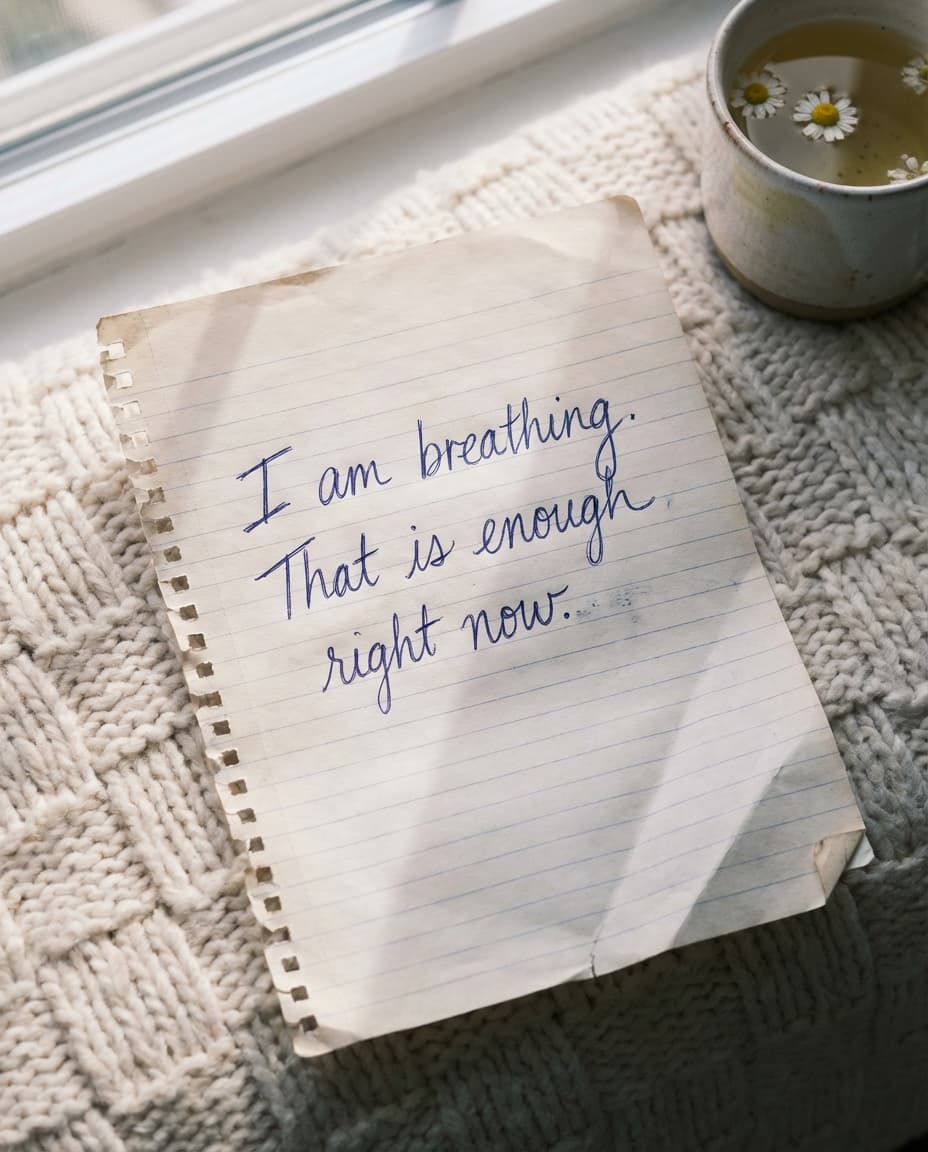
1. I am breathing. That is enough right now.
Focus on the breath coming in and the breath going out. You don't need to do anything else.
2. This is a panic attack. I know what this is.
Naming the experience reduces its power. The Cleveland Clinic lists this as one of the first steps for managing an active attack: acknowledge what it is. Your heart is fine. Your body is safe. The alarm is false.
3. My body is doing something scary, but it isn't doing something dangerous.
Panic attacks are deeply uncomfortable. They are not medically harmful. Your body's alarm system misfired, and it will reset.
4. This will pass. It always has.
Every panic attack you've survived ended. This one follows the same pattern.
5. I don't need to fight this. I just need to wait it out.
Resistance increases tension. Letting the wave move through you isn't surrendering. It's trusting your body to do what it's done every time before.
6. I can feel my feet on the ground.
Sensory anchoring pulls attention from internal chaos to external reality. Press your feet into the floor. Name what you feel: the texture, the temperature, the pressure.
7. Breathing in, four counts. Breathing out, six counts.
This isn't a thought. It's an instruction. Give your brain a task instead of a belief.
When the Wave Pulls Back
The attack ended, but you're not fine. Your hands might still shake. Your chest feels tight. There's an exhaustion that people who haven't been through it don't understand.
This phase is where self-compassion matters most. A 2021 randomized controlled trial at the University of Queensland found that a brief self-compassion intervention improved depression and PTSD symptoms. The mechanism isn't population-specific: treating yourself with kindness after a hard experience changes how your brain files it.
8. I just got through something hard. I'm allowed to rest.
You don't need to bounce back immediately. Recovery isn't weakness.
9. The panic lied to me. My body is safe.
Your body told you that you were in danger. You weren't. Stating that fact after the attack helps your brain file the experience correctly.
10. I don't have to understand why that happened right now.
Sometimes there's no trigger. Panic disorder, as the NIMH defines it, involves unexpected attacks that arrive without warning. Not knowing why doesn't mean something deeper is wrong.
11. What I felt was real. What I feared was not.
The physical sensations were genuine. The belief that you were dying was not. Both things are true at the same time.
12. One panic attack does not decide the rest of my day.
Twenty bad minutes. Then lunch. Then maybe a walk that surprises you by being fine. The day is longer than the attack.
13. I'm still here. That counts for more than I think.
Simple survival is underrated. You made it through again.
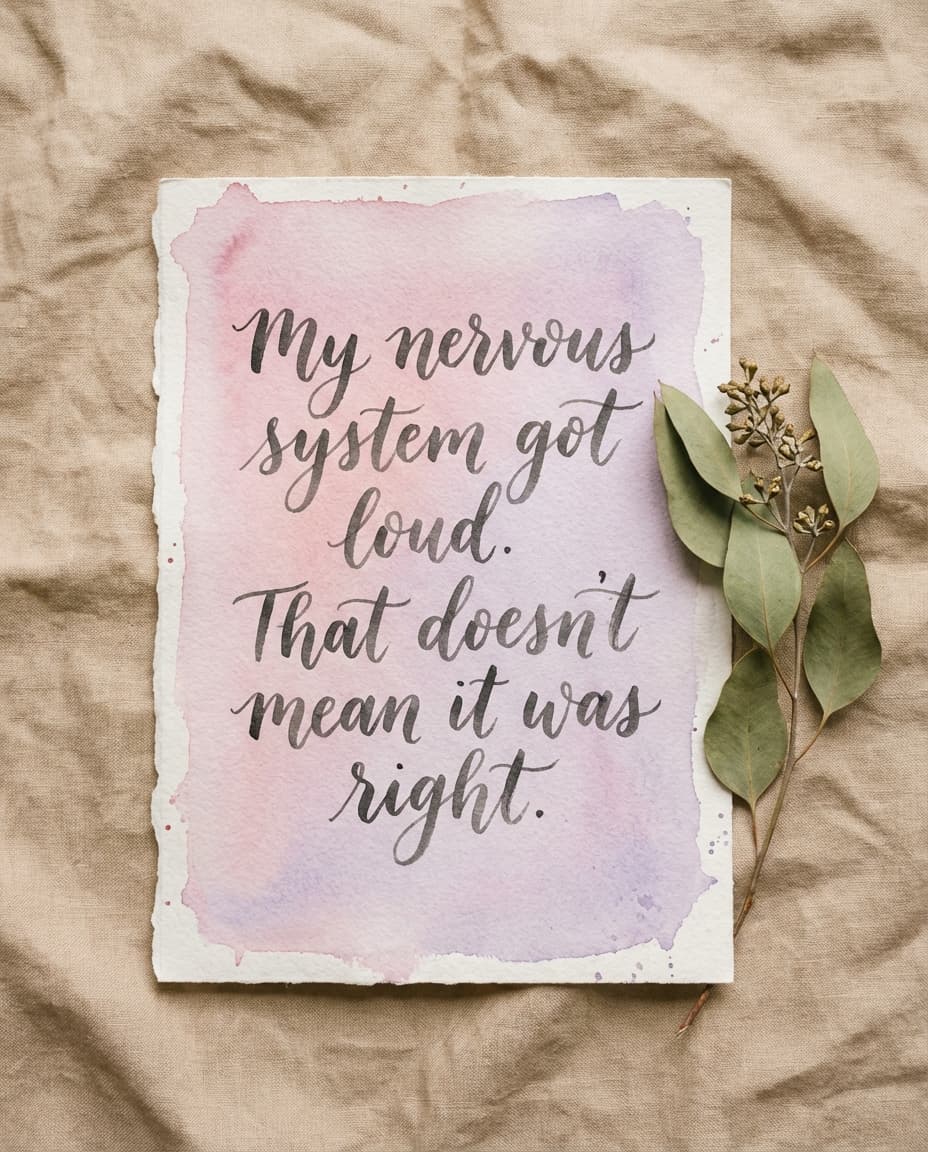
14. My nervous system got loud. That doesn't mean it was right.
Adrenaline doesn't have judgment. It has volume.
When You're Bracing for the Next One
Anticipatory anxiety is often worse than the attack itself. The NIMH notes that one of the diagnostic criteria for panic disorder is "persistently worrying about having more panic attacks or their consequences."
This section is for the days when you're technically fine but can't stop scanning your body for signs that another one is coming.
15. I am not my last panic attack.
What happened last time is information, not prophecy.
16. Monitoring my heartbeat won't prevent anything. I can choose to stop checking.
Hypervigilance feeds the cycle. You notice a normal heartbeat variation, interpret it as a warning sign, and the anxiety from that interpretation produces the symptoms you feared.
17. I've survived every panic attack I've ever had. My track record is 100%.
This is arithmetic, not optimism.
18. Avoidance feels safe, but it makes the world smaller.
Skipping the grocery store. The train. The meeting. Each avoided place confirms the fear instead of challenging it.
19. I can feel anxious and still go.
Anxiety isn't a stop sign. It's a sensation. You can feel it and walk through the door anyway.
20. The next attack, if it comes, will also end.
You're afraid of a future attack. But that future attack has the same 10-minute peak and the same 20-minute ceiling as the last one.
21. I'm learning to separate sensation from danger.
A racing heart can mean excitement, exertion, caffeine, or nothing at all. Not every physical signal means panic. Your body produces hundreds of sensations daily. Most of them mean nothing.
Panic attacks take enough from you already. Affina builds personalized affirmations around what you're going through this week, so you have the right words when your brain can't find its own.
Try Affina freeWhen Panic Makes You Feel Broken
Roughly 4.7% of U.S. adults will experience panic disorder at some point in their lives. Women are twice as likely to develop it as men. It runs in families, with a 40% increased risk if a first-degree relative has it.
None of those facts make it feel less isolating.
Shame often follows panic. The fear that you're fundamentally flawed, that other people don't have bodies that betray them like this.
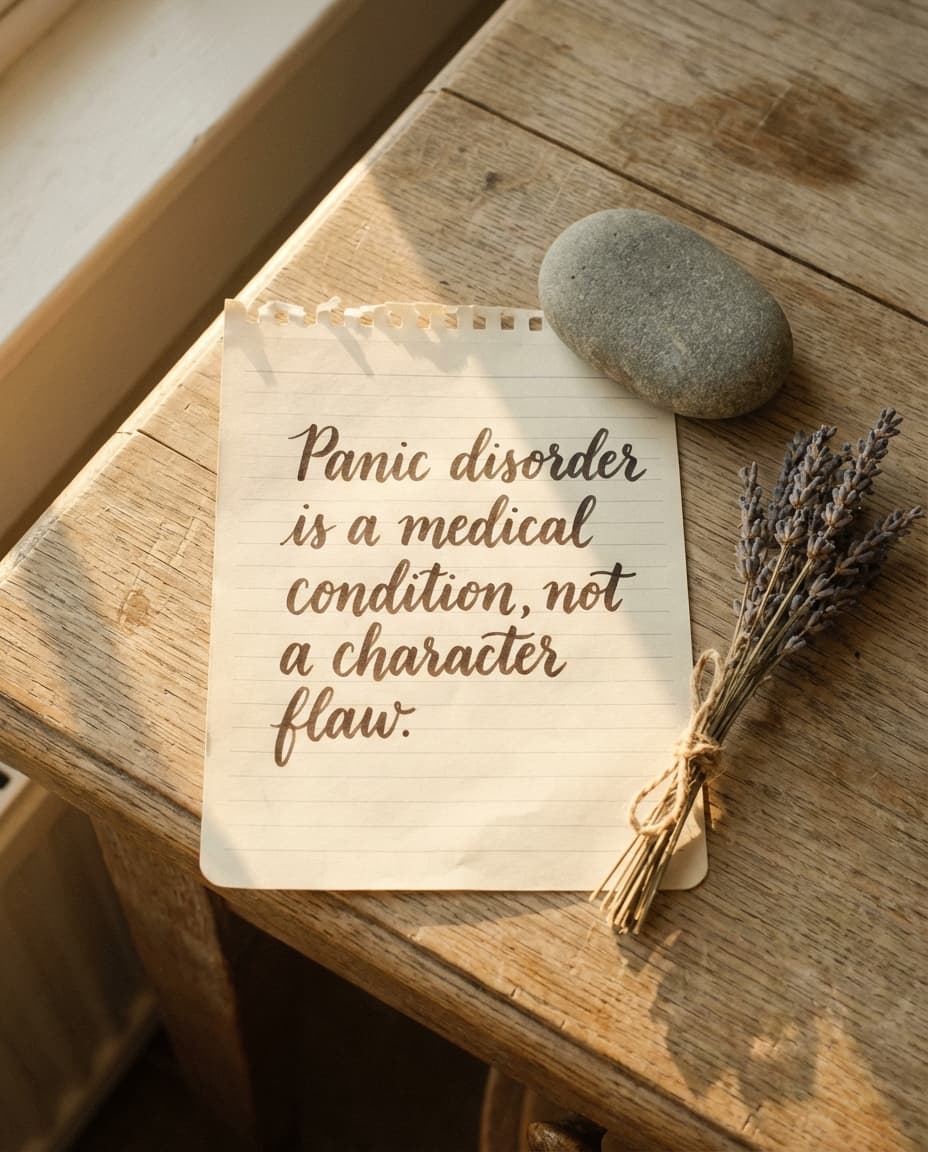
22. Panic disorder is a medical condition, not a character flaw.
The Cleveland Clinic, the NIMH, and the WHO all classify it under anxiety disorders. It involves brain chemistry, not willpower.
23. Millions of people live with this. I'm not the only one in the room pretending everything is fine.
An estimated 2.7% of U.S. adults have panic disorder in any given year. In a typical office of 40 people, at least one of them understands exactly what you're going through.
24. I don't owe anyone an explanation for what my body does.
You can leave the room. You can cancel the plan. You don't have to justify a medical symptom.
25. This condition does not define my capability.
Surgeons, pilots, teachers, parents. People with panic disorder do all of it. The attacks interrupt. They don't disqualify.
26. Asking for help is a decision, not a defeat.
Cognitive behavioral therapy is the most effective treatment for panic disorder. Medication helps too. Reaching out to a therapist is the same kind of decision as seeing a doctor for a broken bone.
27. I am more than my worst moments.
The version of you mid-attack is not the truest version of you. It's the version with the fewest resources available.
28. My brain learned this fear response. It can unlearn it.
Neuroplasticity works in both directions. The pathways that fire during panic can be retrained through exposure therapy, CBT, or consistent new experiences. Research by Dutcher et al. (2020) showed that self-affirmation physically changes activity in brain regions tied to threat regulation.
Between Attacks: Building a Daily Practice
The affirmations above are reactive. These are proactive. They work best when your nervous system is calm and your prefrontal cortex is fully online.
Practicing affirmations between attacks is supported by the same Wang et al. meta-analysis that found self-affirmation benefits "persist over time, with an average follow-up time of nearly two weeks." Consistent practice builds a cognitive pattern your brain can fall back on under stress.
29. I choose to respond to my body with curiosity, not fear.
When a sensation arrives, the default reaction is to brace. Curiosity breaks the pattern. Instead of "here it comes again," try "what else could this be?"
30. Today, I'm practicing being in my body without bracing for the worst.
Presence without vigilance. That's the skill, and it improves with repetition.
31. I'm building a relationship with my nervous system, not fighting a war against it.
Your sympathetic nervous system isn't the enemy. It's the same system that gives you energy, focus, and the reflex to catch something before it falls. The problem is calibration, not the system itself.
32. Calm is not something I have to earn. It's something I can practice.
You don't need a panic-free week to deserve peace. Practice on the ordinary days so it's accessible on the hard ones.
33. I am safe right now. I can let my body know that.
Place your hand on your chest. Slow your breath. Your nervous system responds to physical signals, not just words.
34. What I practice in quiet moments becomes available in loud ones.
This is the logic behind daily affirmation practice. You're training a neural pathway so it fires when you need it most.
35. I'm learning to live alongside this. That is enough progress for now.
Recovery from panic disorder isn't a straight line. Some weeks are worse than others. The fact that you're practicing puts you ahead of where you were when you first typed "affirmations for panic attacks" into a search bar.
How to Use These Affirmations for Panic Attacks

You don't need all 35. You need two or three that feel true enough to hold onto.
For mid-attack: Screenshot the phrases from the first section. Put them somewhere you can reach in under five seconds: your phone's lock screen, a pinned note, a card in your wallet.
Mid-panic is not the time to scroll through an article.
For the hours after: Read through the recovery section once the shaking stops. Pick the one that lands. Say it out loud if you can. Speaking activates additional neural processing that silent reading doesn't.
For daily practice: Pick one affirmation from the last section. Pair it with something you already do: morning coffee, brushing your teeth, sitting down at your desk. Habit stacking (attaching a new behavior to an existing routine) is the most reliable way to build consistency.
If an affirmation feels false, scale it back with bridge language. "I can survive this" becomes "I'm learning that I can survive this." "My body is safe" becomes "I'm open to the possibility that my body is safe." Bridge phrases work because they describe a direction, not a destination. Your brain accepts them without argument.
For the science behind why affirmations work (and why the wrong kind backfire), our full guide to self-affirmation theory covers the research.
The 5-4-3-2-1 grounding technique pairs well with these affirmations during or after an attack. Name five things you can see, four you can touch, three you can hear, two you can smell, one you can taste. Grounding redirects attention from internal panic to the physical world.
If grief sits underneath your panic, those affirmations go deeper into what you might be carrying.
Panic attacks take something from you every time they happen. Not just the minutes they last, but the confidence that your body is on your side. That confidence can be rebuilt. Not through force, but through the patient, honest work of reminding yourself what's actually true.
What changes when you stop treating panic as proof that something is wrong with you, and start treating it as a signal your nervous system needs recalibration?
Your panic attacks are personal. Your affirmations should be too. Affina creates phrases matched to what you're going through right now.
Start your practicePanic Attack and Crisis Resources
These affirmations are one tool. For panic disorder, they work best alongside professional treatment. If you're in crisis or experiencing thoughts of self-harm, reach out now.
- 988 Suicide and Crisis Lifeline: Call or text 988 (available 24/7)
- Crisis Text Line: Text HOME to 741741
- SAMHSA National Helpline: 1-800-662-4357 (free treatment referrals, available 24/7)
- Psychology Today therapist finder: psychologytoday.com/us/therapists (filter for "panic disorder" or "anxiety")
- ADAA therapist directory: adaa.org/finding-help (Anxiety and Depression Association of America)
Panic disorder is treatable. CBT, exposure therapy, and medication help most people improve significantly. The first step is telling someone.