

Seventy-six percent of employees experience burnout at least sometimes, according to Gallup's workplace research. Nearly a third report feeling burned out "very often" or "always."
Those aren't people who lack willpower or self-care routines. They're people working inside systems that take more than they give back. And by the time burnout becomes obvious, the internal damage has been building for months.
These 40 affirmations for burnout are organized around what's actually breaking down inside you. The World Health Organization classifies burnout through three dimensions: exhaustion, cynicism, and reduced professional efficacy. We start there, then move into workplace boundaries, the guilt that follows rest, and what recovery actually feels like. Find the section that matches where you are right now.
Why Most Burnout Affirmations Don't Work
"I am unstoppable." "I radiate positivity." "Every day is a fresh start."
If reading those made you want to throw your phone, you're in good company. Standard affirmations assume a baseline of emotional energy that burned-out people don't have. Telling yourself you're thriving when your body keeps score differently isn't affirmation. It's denial.
A 2025 meta-analysis published in American Psychologist, covering 129 studies and 17,748 participants, confirmed that self-affirmation exercises produce real improvements in well-being and reduced negative symptoms. But the affirmations that work share a pattern: they're grounded in values you actually hold, not aspirational statements your brain immediately rejects.
That's why these affirmations use bridge language. Instead of "I am calm and centered," you'll find "I'm learning to rest without guilt." Your brain can't argue with that. It's already true the moment you think it.
For more on how to write affirmations that your brain actually believes, including the bridge technique, we've written a full guide.
When You're Exhausted and It Shows
The first dimension of burnout is the one most people recognize. The WHO calls it "feelings of energy depletion or exhaustion." It's the bone-deep tiredness that sleep doesn't fix.
A 2005 study by Creswell and colleagues in Psychological Science found that reflecting on personal values before a stressful task lowered participants' cortisol levels. Burnout keeps your stress response locked in the "on" position. Affirmations that connect to what you value can help turn the dial down.
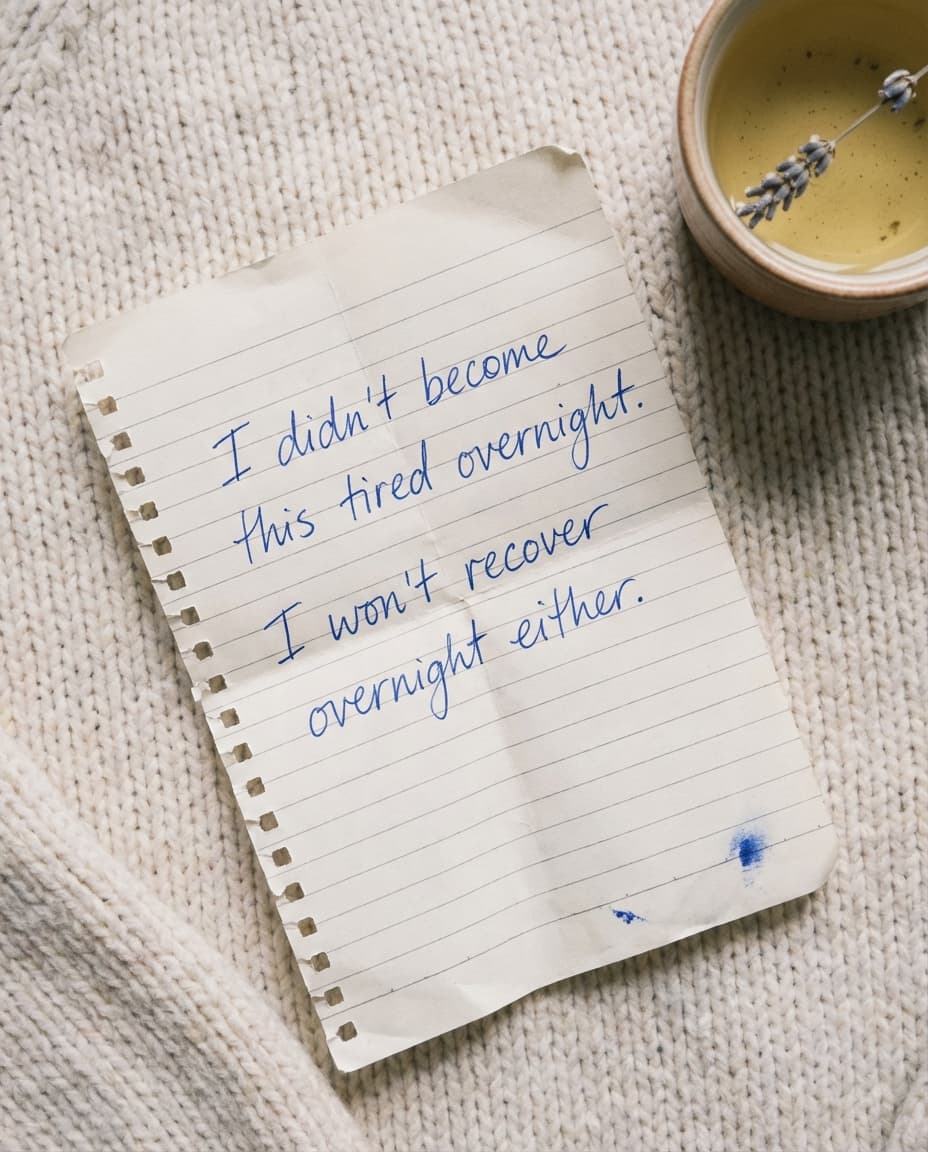
1. I didn't become this tired overnight. I won't recover overnight either.
Burnout accumulates slowly. So does recovery. The expectation that you should bounce back in a weekend is part of the culture that burned you out in the first place.
2. My body has been asking me to stop. I'm listening now.
The headaches, the insomnia, the jaw you clench without noticing. Those aren't character flaws. They're signals you've been overriding for too long.
3. Rest is not the opposite of productivity. It's the condition for it.
You already know this intellectually. The hard part is believing it applies to you, specifically, today, when the inbox is full and the deadline hasn't moved.
4. I am allowed to function at less than full capacity.
Sixty percent on a bad day. Forty on a worse one. Whatever you can give today is enough today.
5. Exhaustion is information, not a personal failure.
If your car's engine overheated, you wouldn't blame the car for being weak. You'd check whether something in the system was broken. Apply the same logic to yourself.
6. The work will still be there tomorrow. I might not be, if I don't stop.
Gallup found that burned-out employees are 23% more likely to visit the emergency room. That's not a scare tactic. It's what happens when "I'll rest later" becomes the default.
7. I can say no to one thing today. Just one.
You don't need to overhaul your entire schedule. One "no" to one request you don't have the bandwidth for. That's the minimum viable boundary.
8. What I need right now matters more than what everyone else expects.
The people asking things of you will survive a delayed response. Your body has been less patient.
When You've Stopped Caring and It Scares You
The second dimension of burnout is cynicism and detachment. The WHO describes it as "increased mental distance from one's job, or feelings of negativism or cynicism related to one's job."
This is the phase where you stop caring about work that used to matter to you. Emails go unanswered not because you're busy, but because you can't make yourself care. You watch yourself becoming someone you don't recognize.
9. Losing motivation doesn't mean I've lost my purpose.
Burnout strips the feeling away. The purpose is still there underneath, buried under months of depleted resources. You didn't change. Your capacity to access what drives you did.
10. Cynicism is a defense mechanism, not my personality.
The sarcasm, the eye-rolling, the dark jokes about quitting. Your psyche built that armor to survive continued disappointment. It served a purpose. It doesn't have to be permanent.
11. I used to care about this work. That person isn't gone.
The fact that you're worried about not caring is proof. People who've truly given up don't notice the absence. You notice. That matters.
12. Detachment is my mind's way of surviving a situation my body can't sustain.
You didn't choose to stop caring. Your nervous system made a calculated decision to conserve whatever energy you had left.
13. I can acknowledge that something is broken without pretending I can fix it alone.
Sometimes the cynicism is accurate. The system really is dysfunctional. The meeting really is pointless. The difference is whether you stay stuck in the observation or move toward a response.
14. Not every thought I have about work right now reflects reality.
Burnout distorts perception. Everything looks worse through exhaustion. Before you act on the thought that you should quit or burn it all down, check whether that's burnout talking or honest assessment.
15. I'm allowed to feel disconnected without making permanent decisions about it.
The worst career decisions happen at the bottom of a burnout cycle. Feel the detachment. Name it. But wait until you have more resources before you decide anything irreversible. (If burnout is pushing you toward a new job, we have affirmations for that transition too.)

When You Don't Trust Your Own Competence Anymore
The third dimension: reduced professional efficacy. The WHO's language is clinical. The experience is personal. You feel incompetent at a job you used to do well. Simple tasks take longer. You second-guess decisions you'd have made in seconds a year ago.
A 2013 study by Creswell and colleagues found that self-affirmation restored problem-solving performance in chronically stressed individuals to the level of their unstressed peers. The mechanism: stress narrows cognitive flexibility, and self-affirmation widens it back.
16. I'm not getting worse at my job. I'm depleted.
Burnout mimics incompetence. The foggy thinking, the slow processing, the mistakes on things you know how to do. That's depletion, not decline.
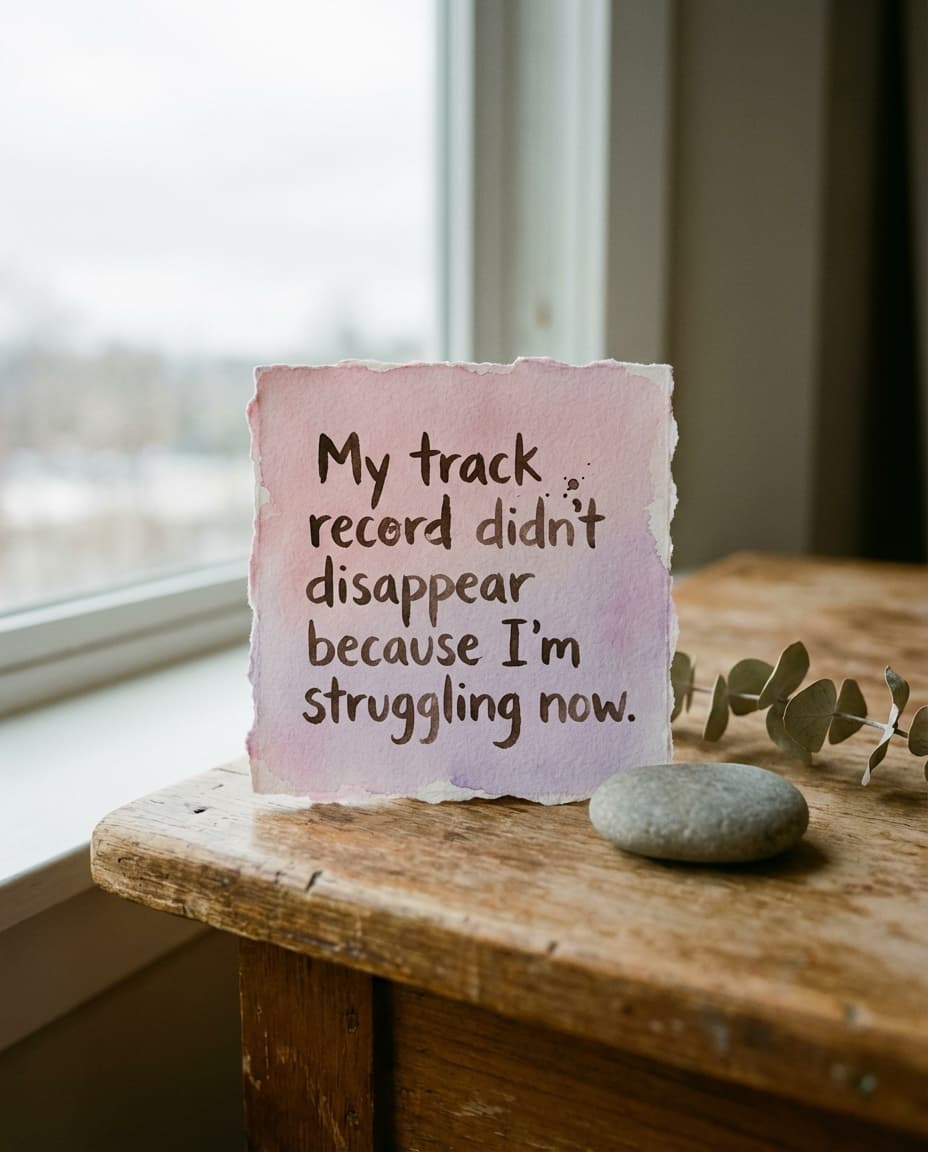
17. My track record didn't disappear because I'm struggling now.
Go look at something you did well six months ago, a year ago. That person built those results. That person is you, running on empty.
18. Struggling in bad conditions is not the same as failing.
A plant that wilts in a dark room hasn't forgotten how to grow. It's responding to its environment. So are you.
19. I don't need to prove my worth to anyone today, including myself.
The compulsion to overperform your way out of burnout is the same pattern that created it. More effort won't fix a resource deficit.
20. My value at work is not the same as my value as a person.
Burnout collapses this boundary. When professional efficacy drops, it can feel like you're failing at being a human. Those are separate things. One is a job. The other is a life.
21. Asking for help is a professional skill, not a confession of weakness.
The people around you can't see your internal state unless you tell them. Asking for support, for an extension, for a reduced scope isn't weakness. It's the most efficient path to not collapsing.
22. I can do meaningful work again. Just not all of it right now.
One task. One email. One conversation done well. Start there.
When the Problem Is the Workplace, Not You
Gallup's research identified the top five causes of burnout: unfair treatment, unmanageable workload, unclear communication from managers, lack of manager support, and unreasonable time pressure. All five are organizational. None are personal.
This matters because burnout culture often frames the problem as individual: you need better boundaries, better self-care, better time management. Sometimes that's true. But sometimes the workplace is genuinely broken, and no amount of meditation will fix a 60-hour week on a 40-hour salary.
23. I am not responsible for fixing a system that's built to run people into the ground.
You can work within it, push back against it, or leave it. But taking personal responsibility for organizational dysfunction is a fast track to deeper burnout.
24. Setting a boundary is not the same as being difficult.
Leaving at 5 PM when you're contracted until 5 PM isn't "quiet quitting." It's the terms of your employment. The discomfort you feel about it says more about the culture than about you.
25. A job that requires all of me is taking more than it's paying for.
Every role has a cost. When the cost exceeds what the role gives back (financially, professionally, personally), the equation is broken. You're allowed to name that.
26. I can care about my work without sacrificing my health for it.
These aren't opposites. The belief that they are is how burnout becomes normalized. Good work requires a person healthy enough to do it.
27. My manager's inability to plan does not make everything my emergency.
Poor upstream planning creates downstream urgency. That urgency is real, but the accountability sits with whoever failed to plan, not with whoever is expected to absorb the consequences.
28. I deserve the same compassion I'd give a colleague in my position.
If a coworker told you they were exhausted, overwhelmed, and losing confidence, you wouldn't tell them to try harder. Extend yourself the same response.
When You Feel Guilty for Resting
Burnout and guilt travel together. You rest, and then you feel guilty about resting. You take a sick day and spend it anxious about falling behind. The voice that says "you should be doing more" doesn't quiet down just because you stopped working.
29. Guilt about resting is a symptom of the problem, not proof that I should keep going.
The guilt is conditioned. It comes from years of equating productivity with worth. Recognizing it as a symptom, not a signal, is the first step toward ignoring it.
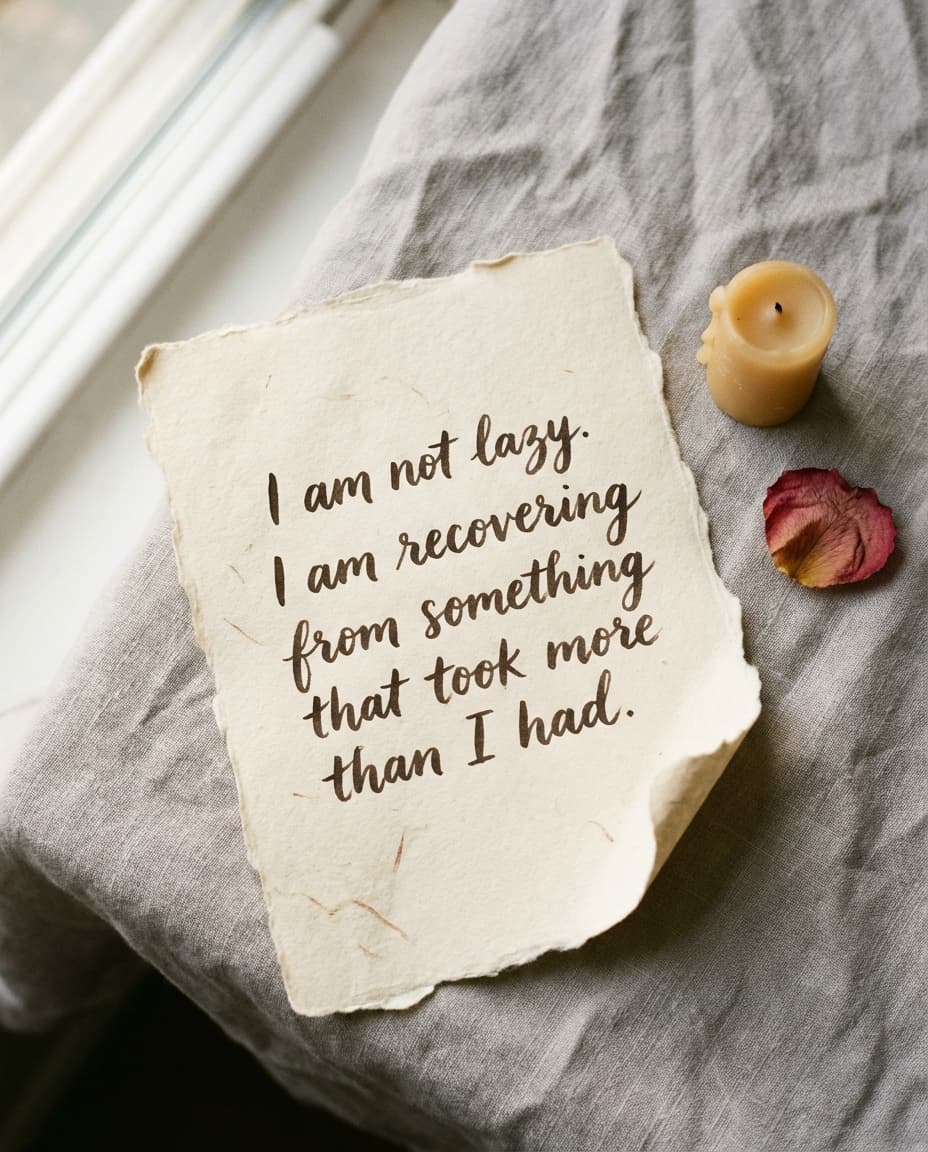
30. I am not lazy. I am recovering from something that took more than I had.
Lazy people don't feel guilty about resting. The guilt itself is evidence that you're the kind of person who cares, which is exactly the kind of person burnout targets.
31. Taking a break before I break down is not quitting early.
Picture the last time you saw someone completely burn out. The leave of absence, the tearful resignation, the health scare. Preventive rest looks boring by comparison. That's the point.
32. My worth is not measured by my output.
What did you do today? Not at work. What did you eat, who did you talk to, what made you feel something? Those answers matter more than your task list, even if your calendar disagrees.
33. The world kept turning every time I've stepped away before.
Check the evidence. Every vacation, every sick day, every time you were unreachable for a few hours, the world continued. The emails got answered, or they didn't, and it still didn't matter as much as you feared.
34. I can rest without earning it first.
Rest isn't a reward for finishing the to-do list. It's a biological requirement. You don't earn sleep by being productive enough. You sleep because you're a human body that needs it.
When You're Starting to Come Back
Recovery from burnout isn't a straight line. It's more like weather: mostly improving, with occasional storms that make you wonder if anything changed at all.
This section is for the days when you catch a glimpse of who you were before the exhaustion took over. When a task interests you again, or you laugh without effort, or you wake up and the first thought isn't dread.
35. Recovery isn't linear, and a hard day doesn't erase the progress.
You'll have setbacks. They feel catastrophic in the moment. They're not. One bad afternoon doesn't rewind three months of rebuilding.
36. I'm allowed to protect the progress I've made, even if other people don't understand what it cost.
Colleagues who didn't see the worst of it won't understand why you're guarding your boundaries so carefully. Protect your recovery anyway. Their understanding isn't required.
37. Rebuilding slowly is still rebuilding.
Speed is part of the culture that burned you out. Recovery that happens at a sustainable pace lasts longer than a sprint back to "normal."
38. I notice what's getting better. That's proof something is working.
The fact that you slept through the night. The meeting that didn't drain you. The idea you had for the first time in months. Small signals are the early data points of recovery.
39. I can build a new relationship with work that doesn't replicate the old one.
Coming back doesn't mean returning to the same patterns. You have information now that you didn't have before, about what depletes you, what sustains you, and what you're no longer willing to trade.
40. I survived it. That's not nothing.
Burnout is a serious occupational health issue. Getting through it, recognizing it, choosing to rebuild rather than repeat: those are real accomplishments. You don't need to be "over it" to be proud that you made it through.
How to Use These Affirmations for Burnout

Don't try to use all 40. That would be the kind of overcommitment that contributed to burnout in the first place.
Pick one section. The one that made you pause. The one where the words felt uncomfortably accurate. Choose one or two affirmations from that section.
Write them somewhere you'll see during the hardest part of your day. Your phone lock screen. A sticky note on your laptop. The notes app you check between meetings.
For a full guide on how to write affirmations that fit your specific situation (including the bridge technique for when these feel too far from your reality), we've covered the method step by step.
The section you need will change as your burnout evolves. What hits on a Wednesday when you're drowning won't be the same thing you need on a Sunday when you're dreading Monday. Come back and find a new one when the old one stops landing.
If these affirmations resonate but you want something that adapts to where you are each week, Affina builds personalized affirmations around what you're actually going through, not generic lists.
When You Need More Than Words
Affirmations for burnout are one tool. They're not therapy, they're not a substitute for medical advice, and they can't fix a workplace that's grinding you down.
If burnout is connected to grief, loss, or a life event beyond work, that layer deserves its own attention too. And if burnout is affecting your daily life, your relationships, or your physical health, talk to someone who can help:
- SAMHSA National Helpline: 1-800-662-4357 (free, confidential, 24/7)
- Crisis Text Line: Text HOME to 741741
- Psychology Today therapist finder: psychologytoday.com/us/therapists (filter by burnout, workplace issues)
- BetterHelp or Talkspace: Online therapy platforms if in-person access is limited
Asking for professional support when you're burned out is the same as going to a doctor when you're physically injured. The stigma is wrong. The need is real.
Burnout reshaped how you think about yourself, your work, and your capacity. These words won't undo that overnight. But they can interrupt the internal monologue that keeps reinforcing the damage.
Sometimes one sentence, repeated at the right moment, is enough to keep you from making a decision you'd regret on a better day. The burnout taught you that your worth lives in your output. Recovery starts when you stop believing that.
You've spent months pushing through on willpower alone. What happens when you replace that voice with one that actually helps? Affina builds affirmations around what you're feeling this week.
Try Affina free