

The Sunday-night spiral before your first day. The 4 AM wake-up your alarm didn't cause. The quiet certainty that everyone will figure out you don't belong there.
If that sounds familiar, you're in the 82% of workers who feel anxious starting a new role. These 40 affirmations for a new job are sorted by what you're going through right now. Start with the section that matches your week.
If those nerves escalate into sudden chest tightness, racing thoughts, or a sense of danger, use the shorter, body-focused affirmations for panic attacks instead.
Before You Walk Through the Door
The gap between accepting the offer and walking in on day one is its own kind of anxiety. You haven't done anything wrong yet, and your nervous system is already treating the situation like a threat.
A 2023 study in the Proceedings of the National Academy of Sciences found that a 15-minute values-based self-affirmation exercise improved reemployment outcomes, increasing both the speed of finding work and the number of offers received. Researchers Julia Pfrombeck and Adam Galinsky at Columbia ran two field experiments, including one with a governmental employment agency. The mechanism: self-affirmation reduces the cortisol-driven defensiveness that makes people underperform in high-stakes situations.
Reminding yourself what you value before you walk in is active preparation.
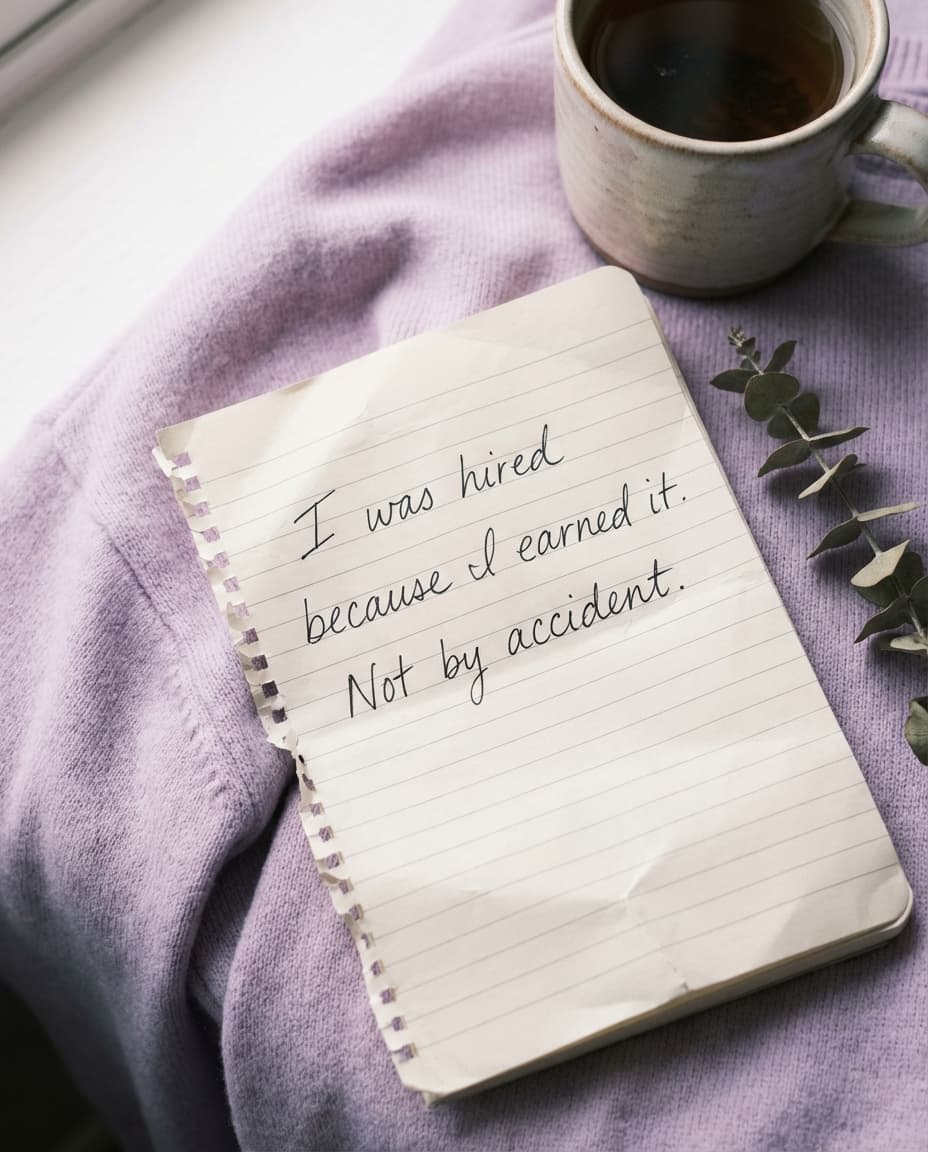
1. I was hired because I earned it. Not by accident.
They reviewed your resume, sat through your interviews, weighed other candidates, and chose you. That process was theirs. Trust their judgment, even when yours is shaky.
2. I don't need to know everything on day one.
Nobody expects you to. They expect you to show up, pay attention, and ask questions. The bar is lower than you think.
3. Feeling nervous means I care about this. And caring is the starting point for everything good.
Apathy is a worse sign than anxiety. The nerves mean this matters to you.
4. I've been new before. I survived it every time.
Think about the last time you started something unfamiliar. School. A previous job. A move to a new city. You didn't feel ready then either. You figured it out.
5. My worth isn't determined by my first impression.
One awkward introduction doesn't define six months of work. People will judge you by what you do over time, not by whether your voice cracked when you said your name.
6. I can be scared and capable at the same time.
Ask any surgeon about their first solo operation. Fear and competence coexist more often than most people admit.
7. What I'm feeling right now is temporary. What I'm building is not.
The anxiety has an expiration date. The skills, relationships, and growth from this job won't dissolve when the nerves do.
When You're the Newest Person in Every Room
A BambooHR study of 1,500 U.S. employees found that 44% of new hires have regrets or second thoughts within the first week. Twenty-three percent admitted to crying. Eighty-seven percent said they hoped to make at least one friend at work.
The first days are an odd mix of sensory overload and social isolation. Everyone else has inside jokes, shortcuts, and histories you're not part of yet.
8. I belong in this room, even if I'm the quietest person in it.
Being new doesn't make you less qualified. It makes you new. Those are different things.
9. Not knowing the culture yet doesn't mean I don't fit.
Culture takes months to absorb. The person who seems effortlessly at home has been there long enough to forget what learning it felt like.
10. I'm allowed to eat lunch alone without it meaning something.
It doesn't mean nobody likes you. It means you're in your first week and your brain needs a break from performing.
11. Every person in this building was new here once.
Your manager. The person who seems to run every meeting. The one who knows where the good coffee is. All of them had a first day where they didn't know anyone's name.
12. I don't have to prove myself today. I just have to learn the coffee machine.
Seriously. Small, stupid goals help. Figure out the printer. Remember two names. Find the bathroom without asking. That's enough for day one.
13. It's okay to not have an opinion in every meeting yet.
Nobody's keeping score. Listening is the job right now.
14. I can ask a question without people thinking I'm incompetent.
They won't. Asking questions signals engagement, not weakness. The silence of someone pretending to understand is far more damaging than any honest question.
15. Connection takes time. I don't need to force it this week.
Workplace friendships build slowly, through shared projects and small moments. Not through forced small talk in your first five days. Let it happen at its own pace.
When You're Convinced Everyone Knows More Than You
Up to 70% of people experience imposter feelings at some point in their lives, according to a systematic review by Bravata and colleagues in the Journal of General Internal Medicine. A 2026 Lab Manager survey found that 43% of employees currently experience those feelings at work. Among Gen Z workers, the number climbs to 66%.
Starting a new job doesn't create imposter syndrome out of nowhere. It gives the version you've been carrying around a new audience and fresh ammunition.
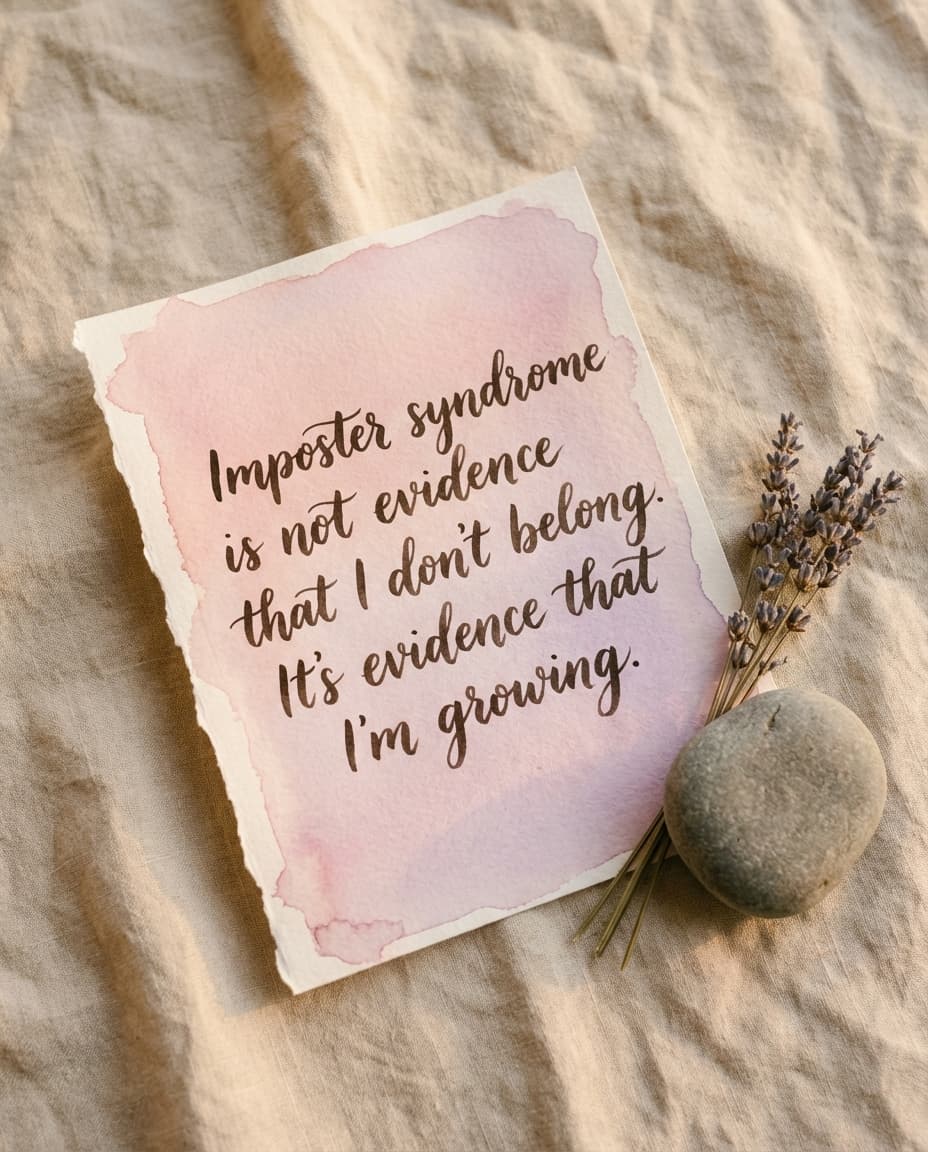
16. Imposter syndrome is not evidence that I don't belong. It's evidence that I'm growing.
Research consistently shows that imposter feelings correlate with conscientiousness and high standards, not incompetence. The people who worry most about being frauds are almost never the actual frauds.
17. I don't need to match my colleagues' confidence. I need to match their effort.
Confidence is a lagging indicator. It shows up after the reps, not before. Focus on what you can control today: the work itself.
18. Comparison is rigged because I'm comparing my insides to their outsides.
You see their composed presentations. They don't see you rehearsing yours three times in the bathroom. The gap between how you feel and how they appear isn't real.
19. They hired me for what I bring, not for what I already know about this company.
Your outside perspective is the asset. Fresh eyes catch things that tenure makes invisible. That's exactly why companies hire externally.
20. "I don't know" is one of the most professional sentences in any workplace.
Followed by "but I'll find out," it's one of the most competent sentences in any workplace.
21. My learning curve is not a performance problem.
Every organization expects a ramp-up period. If yours takes three months, that's standard. Six months for complex roles is still normal. The timeline anxiety is yours, not theirs.
22. I can be good at this job and still feel like I'm faking it.
Have you ever met someone who's clearly competent but insists they're about to be found out? That's what you sound like right now.
From the outside, it's obvious. From inside your head, less so.
23. My past experience counts, even if it looks different on paper.
The problem-solving you did at your last job, the judgment calls, the work habits: all of that came with you. You're not starting from zero. You're starting from a different angle.
24. The fact that I notice what I don't know means I'm paying attention.
Oblivious people don't get imposter syndrome. Your awareness of the gaps is, paradoxically, proof of competence.
When You Make Your First Mistake
It will happen. Not because you're careless, but because mistakes are how humans learn new systems. Neuroscience research suggests that self-affirmation after a setback changes how your brain processes the mistake: as information rather than identity threat.
25. One mistake does not erase the reason I was hired.
Your track record still exists. A missed deadline, a misread process, a wrong assumption: none of these retroactively invalidate your qualifications.
26. I can own what went wrong without making it mean something about who I am.
There's a difference between "I need to fix this" and "I should never have been hired." The first is useful. The second is your anxiety talking.
27. Every person who's good at this job was bad at it first.
Your manager was bad at this job once. So was theirs. The difference between them and you is time, not talent.
28. Asking for help after a mistake shows more strength than hiding it.
The instinct to cover it up is powerful. Resist it. The colleagues who earn the most trust say "I messed this up, here's what happened, here's what I need" instead of hoping nobody notices.
29. My worst day at this job is still a day I showed up.
Your brain is probably suggesting you quit. Brains do that. You're still here, which puts you ahead of the voice in your head.
30. I give grace to others when they make mistakes. I can extend the same to myself.
You wouldn't tell a coworker they should quit over a minor error. Why is the standard different for you? If self-blame tends to spiral, our affirmations for forgiveness go deeper into releasing it.
31. This mistake will teach me something. The shame won't.
Shame makes you hide. Learning makes you better. Pick the one that actually helps.
32. I'll remember this moment in three months and it will feel smaller.
Because it will be. The intensity of a fresh mistake always fades. What felt career-ending at 3 PM on Tuesday becomes a passing memory by October.
When You Miss What You Left Behind
You left behind routines that felt automatic, colleagues who understood your humor, a version of yourself that felt competent without trying. The ADAA reports that 37% of workers say changes to work situations trigger anxiety. Some of that anxiety is grief you haven't named yet.
33. I'm allowed to miss my old job without it meaning I made the wrong choice.
Nostalgia isn't a mistake indicator. You can miss something and still have been right to leave it.
34. I can text my old coworkers. The friendship didn't expire with the job.
The people aren't gone. Just the daily proximity. Keep those connections alive if they mattered. For a deeper look at holding space for loss, our affirmations for grief were written for exactly this feeling.
35. The competence I built before is still inside me. It's adjusting to a new context.
You didn't lose your skills when you changed your badge. You lost the environment where those skills felt effortless. Give yourself time to rebuild that fluency here.
36. I can honor what I left without romanticizing it.
Memory edits out the bad parts. Your old job had frustrations, limitations, and reasons you left. If you left because the pace was grinding you down, our affirmations for burnout are a useful gut check for what you're actually missing and what you're well out of. Missing it is human. Forgetting why you left is selective.
37. I'm not starting from scratch. I'm starting from experience.
Ten years of work didn't vanish because the email signature changed. Different company, same brain.
38. Three months from now, I'll barely remember the name of the person who gave me my badge.
That's how fast this phase passes. The discomfort feels permanent. It isn't.
39. New routines will eventually feel like old routines.
The commute that feels foreign. The coffee machine you can't figure out. The hallway where you still turn the wrong way. Six months from now, all of it will be muscle memory.
40. I chose this. And choosing something hard doesn't mean I chose wrong.
Go back and read the reasons you listed when you accepted the offer. Were they good reasons? Probably. The discomfort hasn't changed the logic.
How to Use These Affirmations for Your New Job

You don't need a morning ritual. You need one sentence ready for the moment your confidence drops.
Pick the affirmation that felt uncomfortably true. Write it in your phone's notes app, in a note titled something boring like "meeting prep" so no one sees it. Read it before your first standup. Read it again after the meeting where you blanked on someone's name.
The commute is your best practice window. That's when new-job anxiety tends to spike, somewhere between leaving your front door and walking into the building. One sentence, repeated in your head, can change the state you arrive in.
If "I belong here" feels like a lie, scale it back. Bridge language works better: "I'm open to the possibility that I belong here." Your brain can't argue with "open to the possibility." It's already true the moment you think it.
The affirmation you need on day one will be different from the one you need on day thirty. When one stops landing, find the next. For the science behind why self-affirmation works (and why the wrong kind can backfire), our full breakdown covers the research.
Six months from now, you'll have a routine, a desk you've made yours, maybe a few people you actually look forward to seeing. The version of you reading this right now won't believe that. But every person who's ever started something new stood in this same gap between terror and belonging.
You crossed it before. You'll cross it again.
Starting something new is hard enough without your inner critic on repeat. Affina builds affirmations around what you're actually going through this week, not what a generic list guesses.
Try Affina free