

Key Takeaways
- These 50 affirmations sort by what you're working through: forgiving yourself, releasing resentment toward someone else, or letting go when no apology is coming.
- Forgiveness means releasing the emotional weight so it stops running your life. It has nothing to do with excusing, forgetting, or reconciling.
- Research from Johns Hopkins Medicine links forgiveness to lower blood pressure, reduced anxiety and depression, better sleep, and decreased risk of heart disease.
- If an affirmation triggers resistance, that's normal. Scale back with bridge language: "I am open to the possibility of forgiveness" instead of "I forgive completely."
Forgiveness is a decision, not a personality trait or a sign of moral superiority. It's a choice you make, sometimes once and sometimes a hundred times for the same wound.
The problem with most forgiveness advice is that it skips the hard part. "Just let it go." As if resentment is a balloon you can release on command.
In practice, forgiveness is slower, messier, and more layered than that. Sometimes you forgive the same person on Monday and wake up furious again on Tuesday.
We organized these affirmations for forgiveness by what you're dealing with. Find the section that fits. Take what resonates. Ignore what doesn't.
When You Need to Forgive Yourself
Self-forgiveness is often the hardest kind. You can't avoid the person who hurt you because the person is you.
A 2015 meta-analysis by Davis and colleagues in the Journal of Counseling Psychology found that self-forgiveness is linked to lower depression, lower anxiety, and better physical health. But the same research shows it's harder to achieve than forgiving others, partly because self-blame has no escape route.
1. I did something I regret. That does not define who I am.
One action, even a bad one, is not your identity. You are the person who did the thing and the person who wishes you hadn't. Both are real.
2. I can hold myself accountable without holding myself hostage.
Accountability means owning what happened and making it right where you can. It does not mean punishing yourself indefinitely.
3. I am learning to separate who I am from what I did.
This is the core of self-forgiveness. The behavior was wrong. You, as a whole person, are not reducible to your worst moment.
4. Punishing myself doesn't undo the harm. Changing does.
Guilt has a purpose: it signals that your actions didn't match your values. Once you've heard the signal, carrying it further doesn't help anyone.
5. I deserved better from myself, and I can start giving that now.
The fact that you fell short before doesn't disqualify you from doing better today. It gives you a clearer picture of what "better" looks like.
6. I can apologize, make amends, and still move forward.
Amends and self-punishment are different things. One repairs. The other just extends the damage.
7. The version of me who made that choice was doing the best they could with what they had.
Not the best possible choice. The best they could manage in that moment, with that information, under that pressure. That distinction matters.
8. I am allowed to outgrow the person I used to be.
Growth requires leaving old versions of yourself behind. You don't owe loyalty to a version of you that no longer exists.

When Someone Hurt You and You're Still Carrying It
Resentment is heavy. Research from Johns Hopkins Medicine shows that chronic anger from unresolved conflict puts your body in a sustained fight-or-flight state, raising blood pressure and increasing the risk of depression, heart disease, and diabetes.
Letting go is about what the weight is doing to you, not about the other person.
9. Holding onto this anger hurts me more than it hurts them.
They may not think about what happened at all. Meanwhile, you carry it everywhere. That imbalance is the cruelest part.
10. I can release this pain without pretending it didn't happen.
Forgiveness is not amnesia. You remember. You just stop letting the memory control your mood, your relationships, and your body.
11. Their actions reflect who they are, not my worth.
Someone else's cruelty is information about them. It says nothing about what you deserve.
12. I refuse to let what they did become the loudest voice in my head.
You get to choose which thoughts get airtime. The ones from the person who hurt you don't deserve a permanent seat.
13. This resentment is a chain. I am the only one it's attached to.
They're free. You're the one still tethered. Forgiveness is cutting the chain, not pretending it was never there.
14. I don't need them to understand my pain for me to heal from it.
Waiting for someone to acknowledge what they did can mean waiting forever. Your healing can't be contingent on their awareness.
15. I am choosing peace over being right.
You might be completely, undeniably right about what happened. And you can be right and still be miserable. Peace doesn't require anyone else's agreement.
16. The space this anger takes up could hold something better.
Resentment occupies real estate in your mind. Every minute spent replaying the hurt is a minute unavailable for something that feeds you instead of drains you.

When Forgiveness Feels Like Excusing What They Did
This is the biggest barrier. The fear that forgiving means saying "it was okay." It wasn't okay. Forgiveness doesn't change that.
Psychologist Everett Worthington, who spent over 30 years researching forgiveness at Virginia Commonwealth University, draws a clear line: forgiveness is an internal emotional shift. It is separate from condoning, excusing, reconciling, or dropping boundaries. You can forgive someone completely and never speak to them again.
17. Forgiving does not mean what they did was acceptable.
It means you're done letting it poison you. Those are different things entirely.
18. I can forgive and still maintain my boundaries.
Forgiveness is about your internal state. Boundaries are about your external safety. One does not cancel the other.
19. Letting go of resentment is not the same as letting them back in.
You can release the anger without opening the door. Forgiveness is a release, not an invitation.
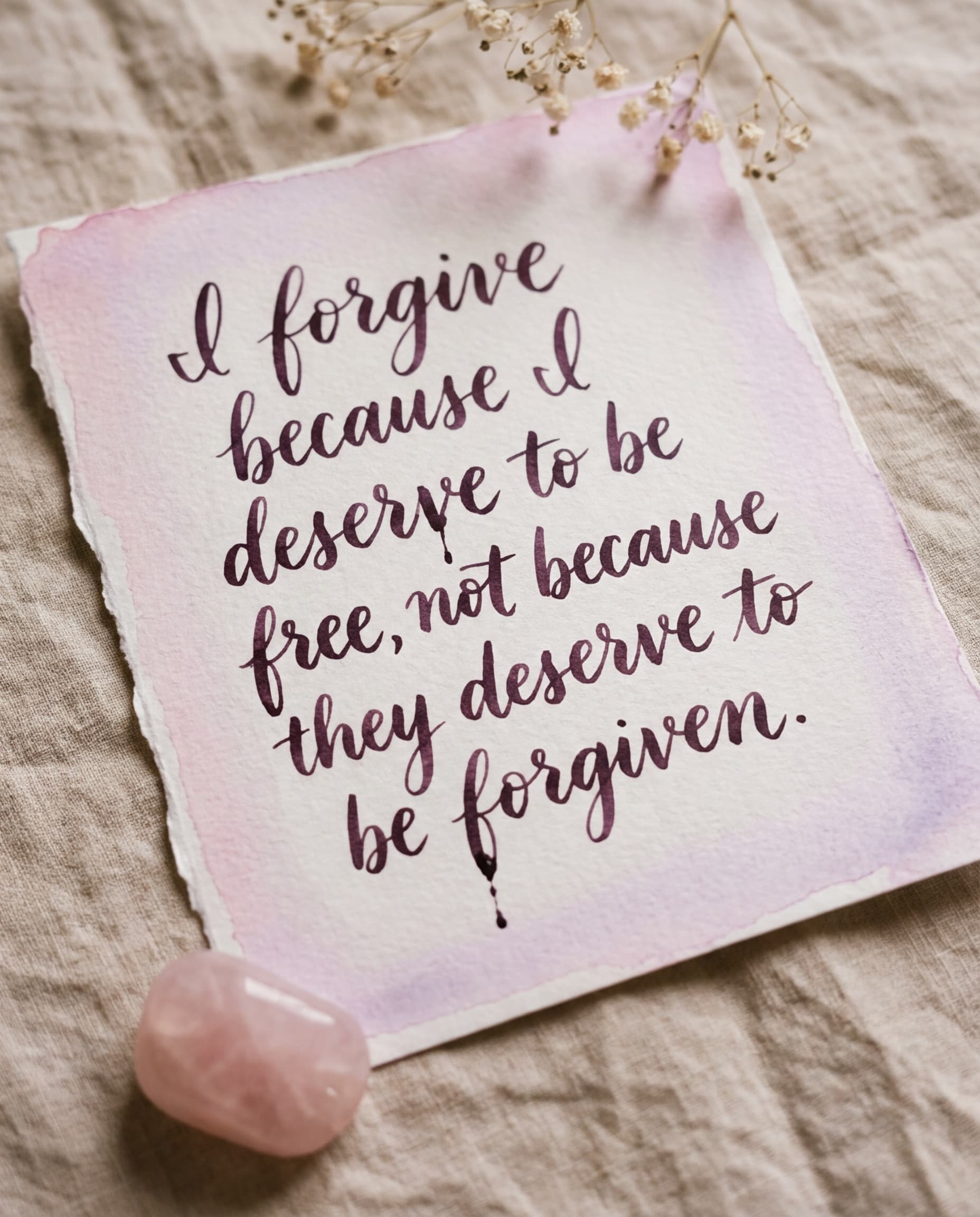
20. I forgive because I deserve to be free, not because they deserve to be forgiven.
This reframes forgiveness from something you give them to something you give yourself. The motivation is entirely selfish, and that's fine.
21. Carrying this weight without breaking was the strong part. Forgiving is where I finally set it down.
You've already proven your strength. Now give yourself permission to stop proving it.
22. I can validate my own pain without needing their remorse.
Your pain is real whether or not they acknowledge it. You don't need their signature to make your experience official.
23. Justice and forgiveness can coexist.
Forgiving someone doesn't mean they escape consequences. It means you escape the emotional prison of waiting for consequences to make you feel better.
Forgiveness isn't a single moment. It's a practice. Affina creates personalized affirmations that meet you wherever you are in the process.
Try Affina freeWhen They Never Apologized
Some people never say sorry. Some can't. Some don't think they did anything wrong.
Waiting for an apology that isn't coming is its own kind of prison.
24. Their silence does not mean I imagined the hurt.
You know what happened. Their refusal to acknowledge it doesn't rewrite the story. It just tells you something about them.
25. I can close this chapter even if they left it open.
You don't need their cooperation to move forward. Your healing is not a collaborative project.
26. An apology would help, but I don't need it to begin healing.
It would be easier with one. But "easier" and "necessary" aren't the same word.
27. I release my need for them to see what they did.
This is one of the hardest affirmations on this list. Understanding might never come. Your peace can't depend on a realization that may never happen.
28. Their inability to apologize is about their limitations, not my pain's validity.
Some people lack the self-awareness, courage, or emotional vocabulary to own what they did. That's their loss. Literally.
29. I can grieve the apology I'll never receive and still move forward.
Grief and forgiveness overlap here. You're mourning something that should have happened but didn't. Let yourself feel that, and then let it pass. (If grief is what you're carrying most, our affirmations for grief may be a better starting point.)
30. Forgiving without an apology is the most powerful form of forgiveness there is.
It's harder, yes. But it proves that your ability to heal isn't dependent on anyone else's behavior. That's real freedom.
When the Anger Keeps Coming Back
You thought you'd forgiven them. Then something triggers the memory and the fury returns like it never left.
This is normal. A 2016 study by Toussaint, Shields, and Slavich in Annals of Behavioral Medicine found that forgiveness is an ongoing process, not a one-time event. It fluctuates.
That doesn't mean you failed.
31. Feeling angry again doesn't mean I haven't forgiven.
Forgiveness isn't a light switch. It's more like a volume dial that you keep turning down, and sometimes something turns it back up.
32. I can notice this anger without letting it move back in.
See it. Acknowledge it. Let it pass.
You don't have to give it a room and unpack its suitcase.
33. Each time I choose to release this, the grip gets weaker.
The first time is the hardest. The fiftieth time is still hard. But the pattern creates a groove that gets easier to follow.
34. This trigger is a memory, not a current threat.
Your body doesn't always know the difference between past and present. But you do.
The danger is over. What remains is the echo.
35. I am allowed to be angry and still be someone who forgives.
Anger and forgiveness are not opposites. You can hold both. The anger gets a visit, not a permanent residence.
36. Ruminating on this does not protect me from being hurt again.
Replaying the hurt feels productive, like you're standing guard. But it's just rehearsing pain.
Boundaries protect you. Rumination doesn't.
37. I don't have to forgive perfectly. I just have to keep choosing it.
Imperfect forgiveness is still forgiveness. You don't lose credit because you had a bad day.
When You're Learning to Let Go
Letting go sounds simple. It's not. It means loosening your grip on something that became part of your identity, even if that something is pain.
Worthington's REACH forgiveness model, tested in an international randomized controlled trial across multiple countries, found that structured forgiveness practice increases hope and reduces anxiety and depression. The model works in steps: Recall the hurt, Empathize with the offender, offer an Altruistic gift of forgiveness, Commit to it, and Hold onto it when doubt creeps back.
You don't have to follow a formal model. But the research confirms what most people intuit: forgiveness is a practice, not a moment.
38. I am ready to put this down, even if I'm not sure how.
Readiness is enough to start. You don't need a map. You just need to stop walking in the same circle.
39. The story of what happened to me is part of me, but it is not all of me.
You are more than your worst experience. The hurt shaped you. It doesn't have to define you.
40. I choose to make room for something other than this pain.
You've been holding it so long it feels like part of your furniture. But you can rearrange. There's space for something else.
41. Letting go is not losing. It's choosing what I carry.
You're not surrendering. You're curating. The things worth carrying are the ones that make you stronger, not heavier.
42. I can honor what I went through without living in it.
The experience mattered. What you learned from it matters.
But the address has changed. You don't live there anymore.
43. I trust myself to know when I'm ready.
Nobody else gets to set the timeline. Not the person who hurt you, not a therapist, not an article on the internet. You'll know.
44. Each day I carry this one day less than I used to.
Progress is hard to see from the inside. But if you look back six months, a year, you'll notice the weight shifted. That's enough.
When Forgiveness Is for You, Not Them
Every affirmation on this list has been building toward the same realization: forgiveness is selfish, and that's the point.
A 2022 meta-analysis in Personality and Individual Differences found a significant positive relationship between forgiveness and subjective well-being. People who forgive report higher life satisfaction, more positive emotions, and fewer symptoms of depression. The benefit accrues to the forgiver, not the forgiven.
45. This forgiveness is my gift to myself.
This one belongs to you. Not to them, not to the relationship, not to anyone watching.
46. I deserve a life that isn't organized around what someone else did to me.
At some point, the hurt became the organizing principle. Your schedule, your triggers, your avoidance patterns, all arranged around the wound.
You deserve a different floor plan.
47. Releasing this doesn't erase my story. It rewrites the ending.
The facts stay the same. What changes is whether the story ends with you stuck or with you free.
48. I am more than the worst thing that was done to me.
You are also the person who survived it, who kept going, who is reading this right now looking for a way forward. That person matters more than the wound.
49. Peace is not something I have to earn. It's something I'm allowed to choose.
You don't need to hit some milestone of processing or healing before you're eligible for peace. You can choose it now, imperfectly, and refine later.
50. I forgive. Not because it's easy, but because carrying this is harder.
The weight was never protection. It was just weight. Putting it down is the bravest thing you'll do today.
How to Use These Affirmations

Don't read all 50 and expect something to shift. That's not how this works.
Pick one. The one that made your chest tighten. The one that felt too true. Write it somewhere you'll see it when the resentment flares: your phone lock screen, a note in your wallet, the margin of your journal.
Say it when you need it, not on a schedule. When the anger surfaces in the shower. When you see their name on your phone.
When you catch yourself replaying the conversation for the hundredth time.
If an affirmation feels too big ("I forgive completely"), scale it back using bridge language. "I am open to the possibility of forgiveness" is a valid starting point.
So is "I am willing to consider letting this go." Meet yourself where you are, not where you think you should be.
Your needs will change. The affirmation that helps today might feel hollow in a month, and that's a sign of progress.
When one stops resonating, find another. That's movement, not failure.
If none of these fit exactly, write your own. The most powerful affirmation is one you created from the specific contours of your own experience. Our guide walks through the process step by step.
If you're working through forgiveness within a marriage or long-term relationship, our affirmations for marriage address that specific context, including rebuilding trust after something broke.
For more on what affirmations are and how they work, including the research on self-affirmation theory, we've written a full breakdown.
When Forgiveness Needs More Than Words
Affirmations for forgiveness are one tool. For deep wounds, betrayal, abuse, or trauma, they may not be enough on their own. That's not a failure of the practice. It's a sign that you need support that goes beyond what words on a page can offer.
- REACH Forgiveness Workbook: Free, evidence-based self-directed program from Harvard's Human Flourishing Program
- Psychology Today therapist finder: psychologytoday.com/us/therapists (filter by "forgiveness" as a specialty)
- 988 Suicide and Crisis Lifeline: Call or text 988 (US)
- Crisis Text Line: Text HOME to 741741
Struggling to forgive doesn't mean something is wrong with you. It means the wound was real. Getting help with it is the most honest form of self-respect there is.
Forgiveness is a daily practice, not a single decision. Affina delivers personalized affirmations that evolve with you, for wherever you are in the process.
Try Affina free