

Saturday morning, 7 AM. Your partner is making coffee the wrong way again, using too much cream, leaving a wet spoon on the counter. You're annoyed, and you know the annoyance has nothing to do with coffee.
It has to do with the conversation you didn't finish last Tuesday, the plans that fell through, the feeling that somewhere between the mortgage and the school pickup schedule, you stopped being two people who actually talk to each other.
Marriage does this. It layers small distances on top of each other so gradually that you don't notice the gap until it's wide enough to feel cold.
These affirmations won't close that gap on their own. But they can change the story you're telling yourself while you stand in the kitchen deciding whether to say something or let it go again. Sometimes that internal shift is where the repair starts.
We organized them by season. Not the calendar kind. The kind your marriage cycles through, sometimes more than once in a single year.
When Things Are Good and You Want Them to Stay
Most couples reach for affirmations only after something breaks. That's backwards.
John Gottman's research at the University of Washington, spanning four decades of studying over 3,000 couples, found that stable marriages maintain at least a 5:1 ratio of positive to negative interactions during conflict. Five moments of connection, appreciation, or warmth for every one moment of friction. Couples who fell below that ratio divorced with over 90% accuracy in his predictive models.
Affirmations during the good seasons aren't naive. They're strategic. You're building the reserves your relationship draws on when things get harder.
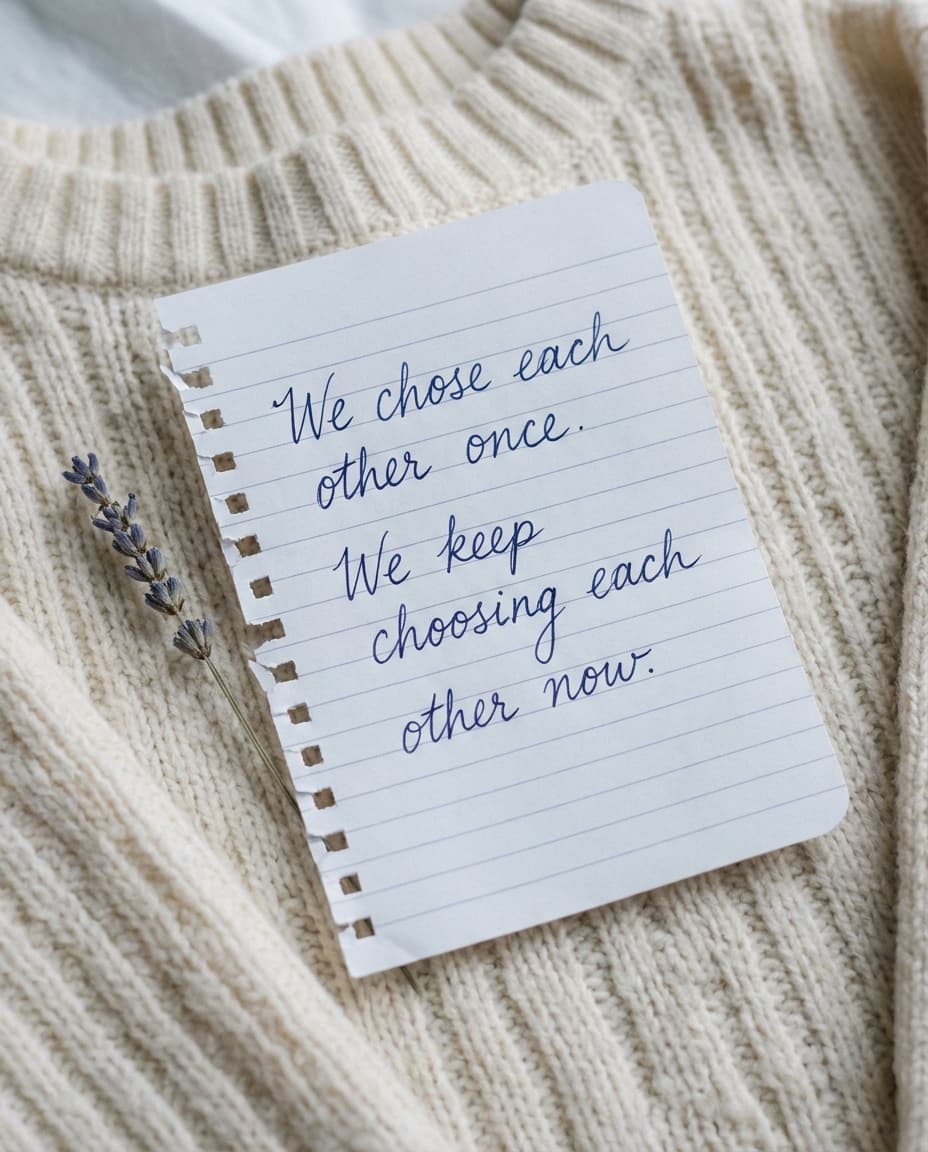
1. We chose each other once. We keep choosing each other now.
Marriage isn't a single decision. It's a decision you remake in small ways, most of them invisible to anyone else.
Choosing to sit next to them instead of across the room. Choosing to laugh at the same joke for the tenth year.
2. I don't take this peace for granted.
Say it on the boring Wednesday when nothing is wrong.
3. My partner's happiness matters to me as much as my own.
Equal weight. When one person's happiness consistently outranks the other's, that's not love. That's a job.
4. We are building something that didn't exist before us.
Your parents' marriage is not the blueprint. Neither is whatever you imagined at 22. This one is being invented as you go, by two people who have never done this particular thing before.
5. I am grateful for the ordinary days.
The extraordinary moments get remembered. But marriages are built on Tuesday evenings and shared grocery lists and the sound of someone else breathing in the dark. The ordinary days are the marriage.
6. What we have is worth protecting.
The threats aren't external. They're the slow erosion of inattention, assumption, and autopilot. In a marriage, protection looks like presence.
7. This relationship makes me better at being myself.
The best marriages don't just maintain who you are. They help you become who you've been trying to be.
If you feel more like yourself around your partner than anywhere else, that's not an accident. It's the relationship doing what it's supposed to do.
When You've Gone Quiet About What Matters
You still talk. About logistics, the kids, what's for dinner. But somewhere along the way, you stopped sharing the stuff underneath: what scares you, what you want, what keeps you awake after they fall asleep.
8. I can be honest about what I need without it being a complaint.
Needs expressed as complaints trigger defensiveness. Needs expressed plainly invite collaboration.
The content is the same. The framing changes everything.
9. Silence protects my comfort, not our connection.
Avoiding the hard conversation feels like keeping the peace. But the peace you're keeping is shallow, and both of you can feel it.
10. My partner can handle my honesty.
You might be protecting them from a conversation they're perfectly capable of having. Sometimes the assumption that they can't handle it says more about your fear than their capacity.
11. I will listen to understand, not to respond.
The difference is whether your partner feels heard or handled. People know when you're constructing a rebuttal while they're still mid-sentence.
12. We can disagree and still be on the same team.
Disagreement in a marriage doesn't mean the marriage is failing. It means two separate people with separate minds are doing the work of sharing a life. The conflict is proof that neither of you has given up trying.
13. Asking for help is not weakness in our marriage.
"I don't know how to fix this" is a stronger sentence than "I'm fine."
14. The conversation I'm avoiding is probably the one we need most.
If you already know which conversation this is, that's your answer.
When You're Rebuilding After Something Broke
Trust cracked. Maybe through betrayal, maybe through neglect, maybe through a season where you both checked out and neither noticed until the damage had already set in.
Rebuilding is slower than breaking. That's just how it works.
15. We can repair what happened without pretending it didn't.
Repair doesn't require amnesia. You carry the knowledge of what broke and you build something more honest around it, the way a bone heals thicker at the fracture line.
16. I am committed to doing my part, even on days it feels pointless.
Some days the effort produces visible progress. Other days it feels like shoveling sand into wind. The results show up on a longer timeline than your patience wants.
17. Trust is rebuilt in small moments, not grand gestures.
Showing up on time. Following through on a promise. Answering the phone when you said you'd be available.
Trust comes back through a thousand unremarkable moments of reliability.
18. I can feel hurt and still believe we're worth fighting for.
Holding both is exhausting, and it's the only honest position during repair. If the hurt were gone, you wouldn't need to rebuild. If the belief were gone, you wouldn't still be trying.
19. My partner's worst moment is not the full story of who they are.
This is not about excusing what happened. It's about deciding whether one chapter gets to end the whole book.
20. Healing on different timelines doesn't mean we're failing.
One of you may be ready to move forward while the other is still processing. That mismatch is normal, not a sign the repair isn't working.
If what broke involves needing to forgive, our affirmations for forgiveness may help with that specific layer.
21. I release the need to keep score.
Scorekeeping feels like fairness. In practice, it's a way of staying armed. Repair requires someone to put down the tally first.
22. I can set boundaries and still be working toward reconciliation.
Boundaries during repair aren't walls. They're guardrails that keep the rebuild on track. You can protect yourself and move toward each other at the same time.
When the Closeness Feels Far Away

You share a bed, a bathroom, and a bank account, and somehow it still feels like you're roommates running a small household together. The closeness didn't leave in one dramatic exit. It thinned out gradually, the way a color fades from overexposure.
Research by Wells, Haase, and colleagues, published in the Journal of Personality and Social Psychology, found that "positivity resonance" (shared moments of genuine positive emotion between long-term married couples) predicted better physical health and even longer lifespan. Closeness isn't just emotionally good for you. It's physiologically protective.
23. I can reach for my partner even when I'm not sure they'll reach back.
Someone has to go first. The risk of reaching out is real. But the cost of both people waiting is always higher.
24. Physical closeness and emotional closeness feed each other.
A hand on their back while they cook. Sitting close enough to touch on the couch. Small physical gestures rebuild the bridge that words sometimes can't.
25. I miss the way we used to talk, and I can invite that back.
You probably can't recreate the exact conditions of early love. But you can create new conditions that make real conversation possible. Start with a question you don't already know the answer to.
26. We stopped building intimacy. We can start again.
"Lost" implies it vanished on its own. But intimacy doesn't disappear. It goes unattended.
The tools are still in your hands.
27. I will notice what my partner does right before I catalog what they do wrong.
The negativity bias is real. Your brain scans for threats, including from the person you love most.
Actively noticing the good is not naive optimism. It's a correction your biology requires.
28. We don't have to feel close to act close.
Waiting until you feel connected before acting connected creates a standoff. Sometimes the action comes first and the feeling follows.
29. I choose curiosity about my partner over assumptions.
After years together, you think you know everything about them. You don't. People change continuously, and the assumption that you already know who they are is one of the quietest ways distance grows.
Marriage has seasons, and so do the words you need. Affina creates personalized affirmations that meet yours, wherever you are in the cycle.
Try Affina freeWhen You're Becoming Different People

You married one version of this person, and they married one version of you. Neither of those versions still exists in exactly the same form.
That's not a problem. Change is not a betrayal of the marriage. It's proof that both of you are still alive.
Research on the Michelangelo effect found that the best relationships work like a sculptor with marble: partners help each other become their ideal selves, not by fixing what's wrong, but by affirming what's trying to emerge. When partners support each other's growth, both personal well-being and relationship satisfaction increase.
30. My partner is allowed to grow, even in directions I didn't expect.
Their new interest, their career shift, their changing beliefs. You don't have to share every evolution. But you do have to make room for it.
31. Our differences make this marriage interesting, not threatened.
Identical couples have nothing to teach each other. The friction between differences is also where the growth happens.
32. I can support their goals without losing mine.
This is the balance every marriage negotiates continuously. Two people with individual ambitions building something shared. Neither set of goals gets to consistently override the other.
33. We are not the same couple we were five years ago, and that's progress.
If your marriage looks identical to five years ago, someone has been standing still. Growth looks unfamiliar from the inside. But look back far enough and you'll recognize it.
34. I choose to be interested in who my partner is becoming.
Shelly Gable's research on interpersonal capitalization found that how partners respond to each other's good news and personal growth predicts relationship satisfaction more strongly than how they handle conflict. Being actively interested in your partner's evolution is one of the most powerful things you can do for your marriage.
35. Parallel growth is still growth together.
She trains for a half marathon while he learns woodworking. They don't share a single hobby, and the marriage is better for it. Two people thriving independently have more to bring home.
36. I will ask who they are now instead of assuming I already know.
People update quietly. The partner you're arguing with inside your head may not match the partner sitting in front of you right now.

When You're Choosing Each Other Again
Every long marriage has moments where the choice to stay becomes conscious. Not always because of a crisis. Sometimes just because the autopilot wore off and you find yourself standing in this relationship on purpose for the first time in a while.
Sometimes that conscious choosing also means grieving the version of the marriage you expected but didn't get. If that grief feels heavy, our affirmations for grief address that specific kind of loss.
37. I choose this marriage with open eyes.
The marriage you imagined at the altar doesn't exist. Neither does the one your parents had. This is yours, with this person, with all the information you have now.
38. Love is something I do, not only something I feel.
The feeling part was involuntary and wonderful. What comes after is deliberate. The deliberate part is where the real marriage lives.
39. My commitment is not a cage. It's the ground I build on.
Commitment gets framed as limitation: all the things you gave up. Reframe it as foundation. Stable ground makes deeper building possible.
40. I am proud of what we've survived together.
Not every couple makes it through what you've made it through. The fact that you're both still here, still trying, is not a small thing.
41. This person knows me better than anyone, and they stayed.
There's a particular kind of courage in being fully known. And a particular kind of love in being fully known and fully chosen anyway.
42. Our story isn't finished yet.
Whatever chapter you're in, it's a chapter. There are pages ahead that neither of you can predict, and some of them will be good ones you never saw coming.
43. I am not perfect, and this marriage doesn't need me to be.
Perfectionism in marriage creates performance. What your partner actually needs is your presence, your honesty, and your willingness to keep showing up imperfectly.
44. My partner doesn't have to be everything. They just have to be here.
Your spouse is not your therapist, your best friend, your financial advisor, and your entire social world. Expecting all of that from one person breaks the relationship. Expecting partnership is plenty.
45. The best parts of this marriage haven't happened yet.
You can't know this for certain. But choosing to believe it changes what you build toward.
How to Use These Affirmations

Don't try to absorb all 45. Find the section that sounds like your marriage today, and pick one or two that land.
Solo practice: Write your chosen affirmation somewhere you'll see it during the moments you need it most. The bathroom mirror, your nightstand, your phone lock screen.
Use it when frustration spikes, when you're about to have the same argument again, when you need a reminder of what you're building.
Couples practice: Pick one affirmation together each week. Put it on the fridge, the dashboard, wherever you'll both encounter it. You don't need to discuss it formally. Let it sit in your shared space.
If an affirmation feels too far from reality, scale it back with bridge language. "Our marriage is strong" becomes "I'm open to believing our marriage can get stronger."
Bridge affirmations state a direction your brain accepts, not a destination it rejects. For a full guide on this technique, read our piece on how to write affirmations.
Your marriage will cycle through these sections more than once. When an affirmation stops resonating, that means the season changed. Come back and find a new one.
That's not regression. That's a marriage working the way marriages work.
For more on what affirmations are and how they work, including the psychology behind self-affirmation theory, we've written a full breakdown.
What would shift in your relationship if you both started saying out loud what you've been thinking quietly?
What would your marriage sound like with the right words at the right time? Affina creates personalized affirmations that fit your relationship, not a generic list.
Try Affina freeOne thing affirmations can't do: fix abuse, active addiction, or long-term unhappiness that hasn't responded to your efforts. If that's where your marriage is, words are the wrong tool. Get professional support.
- Psychology Today: psychologytoday.com/us/therapists/couples (filter by couples counseling)
- Gottman Referral Network: gottman.com/couples/find-a-therapist (certified Gottman therapists)
- National Domestic Violence Hotline: 1-800-799-7233 or text START to 88788
- Crisis Text Line: Text HOME to 741741